
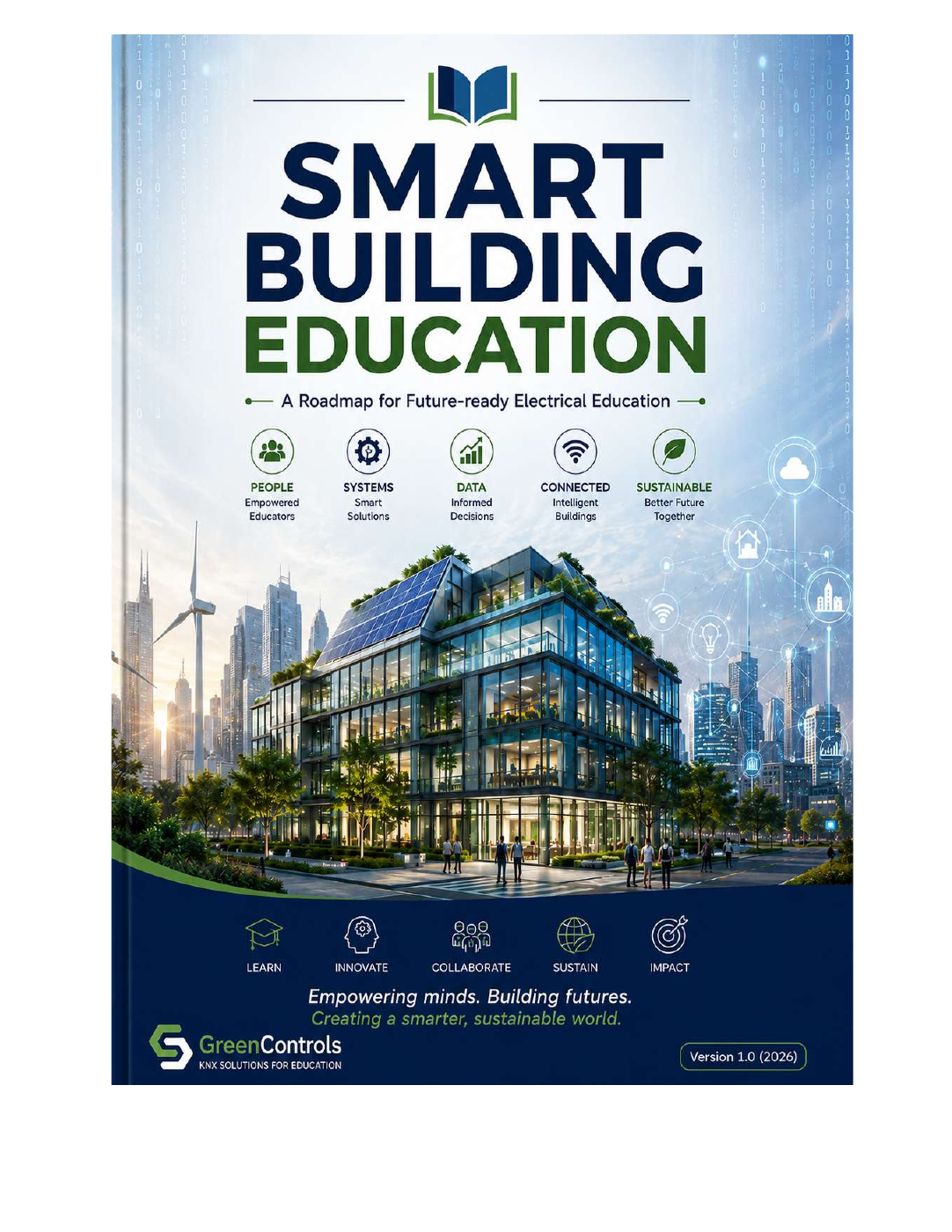
WorldSkills Shanghai 2026 concluded on 27 September. The following day, GreenControls shared a podcast discussion of its Smart Building Education Framework. Competitions can show what highly skilled young professionals are capable of achieving. The question for technical and vocational education and training (TVET) in Thailand is how more learners can build relevant skills in ordinary classrooms and workshops, not only on a competition stage.
GreenControls Technology Co., Ltd. developed Smart Building Education Version 1.0 as a contribution to that conversation. It is a proposal for educators, institutions and industry partners to consider, adapt and discuss—not an official WorldSkills curriculum or an endorsement by any skills authority. Its starting point is straightforward: as buildings change, the way we prepare the people who design, install and maintain them must change too.
Buildings are changing. Fundamentals still matter.
Buildings increasingly combine electrification, digital systems and sustainability goals with rising expectations for comfort, safety and usability. Lighting, climate control, renewable energy and monitoring are less often isolated installations. They must work together, communicate useful information and remain maintainable over time. That broadens the work of an electrical professional: it is no longer only about connecting a device correctly, but also about understanding how that device participates in a larger system.
None of this makes traditional electrical education obsolete. Safe installation, electrical principles, sound workmanship and knowledge of applicable rules remain essential. The framework argues for expanding that foundation, not replacing it. A learner who understands wiring and safety is better placed to grasp control logic, networked devices and the consequences of commissioning choices. Practical competence begins with fundamentals and grows through applications.
Future technicians therefore need opportunities to practise system integration, automation, energy management and open communication standards. They should learn to commission a system, diagnose faults and understand the information that building systems produce. Knowing how to test whether several subsystems work together is different from knowing how to install each one separately. Both skills belong in a modern technical education.
Why an open standard belongs in the classroom
The framework uses KNX as an example of an open building-automation standard. In an educational setting, the value is not simply learning a particular product. Students can explore concepts such as communication, addressing, configuration, interoperability and troubleshooting across devices from different manufacturers. Those concepts can travel with them beyond a single supplier or project.
An open, multi-manufacturer approach also helps institutions avoid building all teaching around one proprietary ecosystem. It does not remove the need to learn specific tools or to work with real equipment; it gives that hands-on work a wider engineering context. The aim is transferable understanding and flexibility as technology changes, rather than a promise that one standard will solve every building challenge.
Learn by doing, then build on what works
The framework treats practical work as central to learning. A student should be able to connect theory with real tasks: plan a control sequence, wire and configure devices, test operation, identify a fault and explain the result. Working through the process—especially when something does not behave as expected—develops judgement that a diagram alone cannot provide.
Its three-level laboratory model gives institutions a staged way to begin and expand. Level 1, the Foundation Lab, is an accessible starting point for basic controls and introductory KNX concepts. Level 2, the Integration Lab, moves towards connecting functions and working with broader system behaviour. Level 3, the Advanced KNX Training Lab, supports more advanced practical training and, where the appropriate training requirements are met, a pathway towards KNX certification. These levels are a planning model, not a claim that every institution already offers certification or must acquire an entire advanced laboratory at once.
The same phased thinking applies beyond equipment. An institution can review existing electrical teaching, identify where building automation fits, develop learning activities and expand facilities as teachers and students gain confidence. Evaluation matters too: feedback from learners, educators and industry can help keep the programme relevant rather than treating a new laboratory as a one-time purchase.
Invest in teachers and partnerships
Laboratories do not teach on their own. Teachers need time, support and opportunities to work with current tools and methods. Professional development helps them connect electrical fundamentals with systems thinking and guide students through commissioning and fault finding—not just demonstrate a finished installation. Teacher capability is therefore part of the framework’s implementation roadmap, not an afterthought.
Education–industry cooperation can make learning more grounded in practice. Institutions can talk with engineers, integrators and employers about the tasks graduates will encounter and the skills that matter on real projects. Industry can share experience and help educators keep pace with changing applications. These relationships should support educational objectives and local needs; the framework is an invitation to collaborate, not a claim of formal endorsement by any organisation.
From excellence in competition to opportunity in education
WorldSkills can make advanced technical skills visible. The broader challenge is to make useful competencies accessible to learners who will never enter a competition. A student in a regular TVET programme should also be able to experience how a smart-building system is designed, integrated, commissioned and maintained. That requires practical teaching pathways, capable educators and room for institutions to start at a scale they can sustain.
At its heart, GreenControls’ framework is about knowledge sharing and skills development. Better preparation can help learners see more possibilities for their careers and lives, while giving the built environment people able to work thoughtfully with evolving technology. The invitation is to discuss what future-ready electrical education could look like in Thailand—and then make that learning real in the classroom.