
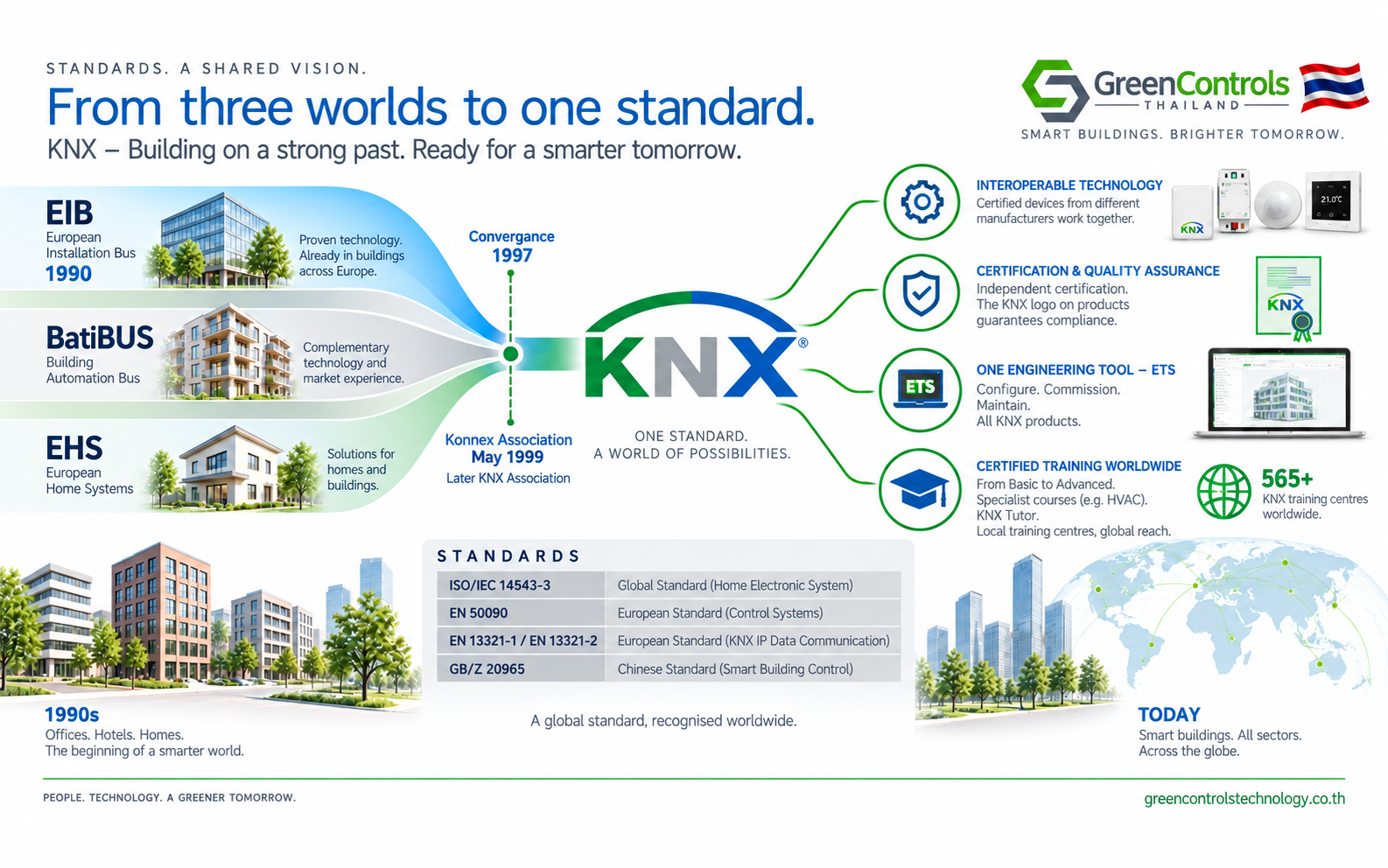
KNX may have adopted its current name around the turn of the millennium, but its technological roots go much further back.
The story began in 1990, with the formation of the European Installation Bus Association and the development of EIB: European Installation Bus.
During the early 1990s, EIB technology was already being installed in homes, offices, hotels, public buildings and many other projects. Engineering software, certified products and professional training followed. What we today recognise as the KNX ecosystem was already beginning to take shape.
From three technologies to one standard
Europe did not have just one building-automation initiative. Alongside EIB were BatiBUS and EHS, European Home Systems.
Rather than allowing three competing technologies to continue developing separately, a convergence process began in 1997.
In May 1999, EIBA, BatiBUS Club International and EHSA joined forces and founded the Konnex Association, later known simply as KNX Association.
But one decision was particularly important:
The existing EIB technology and installed base would not be left behind.
EIB became the technical foundation and core of the KNX system, with backward compatibility protecting earlier investments and allowing installations to evolve instead of becoming obsolete.
That means KNX did not suddenly arrive as a completely new technology around the year 2000. Its DNA had already been operating in real buildings for years.
So, if generational labels also apply to technology, KNX is something of a late Millennial or early Gen-Z system, with very good parents.
Convergence became an ecosystem
What emerged was much more than another communication protocol.
Today, KNX combines several elements that make an open standard genuinely practical:
Interoperable technology Certified products from different KNX manufacturers can operate together within the same installation.
Independent certification The KNX mark on certified products represents conformity with defined KNX requirements. It is not simply a manufacturer declaring that its product is compatible.
One engineering environment: ETS ETS is manufacturer-independent. A system integrator can design, configure, commission, diagnose and maintain KNX devices from different manufacturers within one project.
One international training structure The same principles continue into education. KNX certified training provides a structured path from introductory learning and KNX Basic training through Advanced and specialist courses such as HVAC, and ultimately KNX Tutor qualification.
The technology may be international, but the knowledge is local.
Certified KNX training centres operate around the world, teaching the same standard, the same engineering principles and the same ETS environment.
One standard. Many manufacturers. Generations of buildings.
Perhaps the most important achievement of KNX is therefore not simply that it has survived for more than three decades.
It is that new technology has been allowed to evolve without unnecessarily abandoning what came before it.
Buildings change. Manufacturers change. Software changes. Applications change.
But the principle remains:
One open standard, interoperable products, one engineering environment and internationally recognised knowledge.
That is how a technology born in the early 1990s continues to engineer the smart buildings of today and tomorrow.