
Understand indoor conditions and respond with purpose.
Indoor-air-quality monitoring provides relevant environmental information that can support ventilation control, occupant comfort and informed building operation.
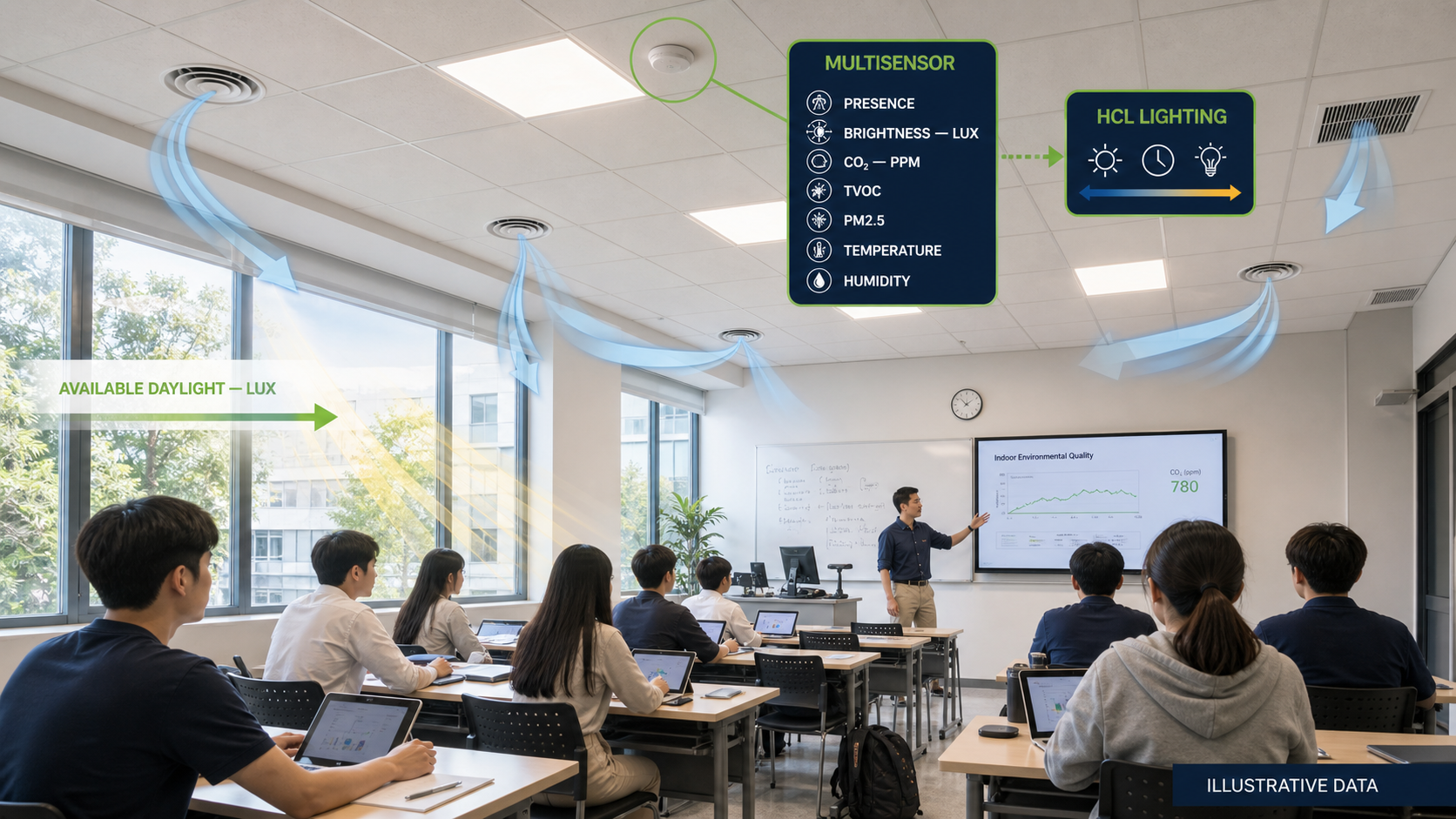
A single measurement does not describe the complete indoor environment.
Indoor conditions may be influenced by occupancy, ventilation, outdoor air, activities, materials, cleaning, equipment and building operation. Relevant measurements should therefore be interpreted together and in relation to how the space is being used.
Measure what matters. Interpret it in context. Respond appropriately.
Six measurement areas to consider.
Carbon dioxide
Use carbon-dioxide measurements as one indicator that may support an understanding of occupancy-related ventilation conditions.
Particulate matter
Monitor relevant particulate levels, such as PM2.5, where required by the building and environmental strategy.
Volatile organic compounds
Use suitable VOC measurements to indicate changes that may require investigation or operational response.
Temperature
Monitor indoor temperature as part of comfort, climate-control and environmental analysis.
Relative humidity
Monitor humidity conditions that may affect comfort, materials and building operation.
Outdoor-air context
Use relevant outdoor measurements or trusted external information to help interpret indoor conditions and ventilation decisions.
Carbon dioxide is not a complete measure of air quality, and not every project requires every measurement. The relevant set should follow the objectives of the space.
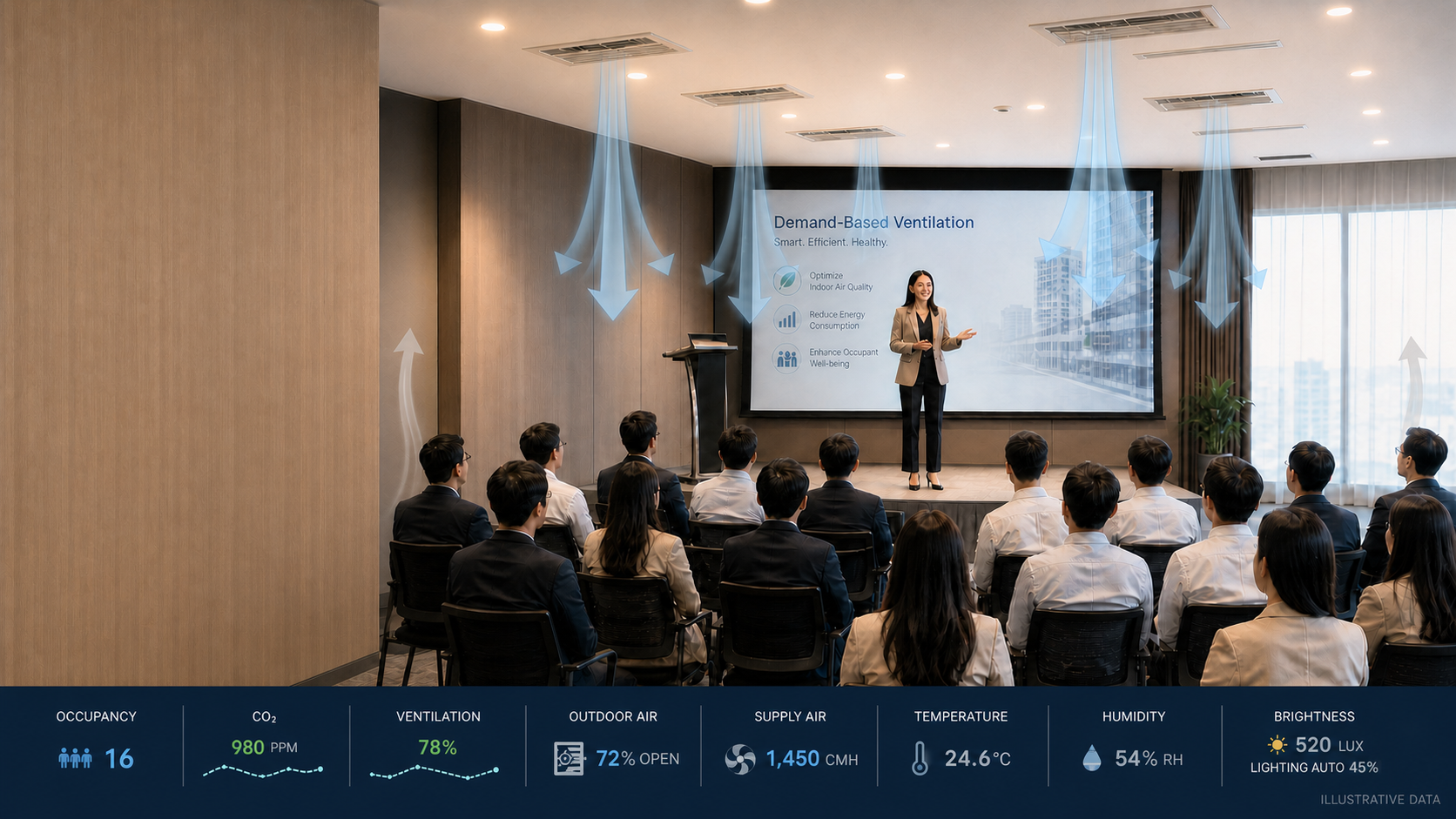
Ventilation demand can change throughout the day.
Occupancy and indoor environmental conditions may vary significantly between spaces and operating periods. Where the mechanical design supports it, relevant measurements can help ventilation respond to actual demand rather than relying only on fixed operation.
Control strategies operate within the approved mechanical design. They do not override statutory or regulatory ventilation requirements.
Outdoor conditions influence indoor-air strategies.
Outdoor particulate matter, temperature, humidity and other environmental conditions may affect decisions about ventilation, filtration and operating modes. The strategy should consider suitable outdoor information together with indoor measurements and mechanical-system capabilities.
Trends often provide more insight than isolated readings.
Historical information can help teams recognise recurring conditions, relate measurements to occupancy and schedules, and investigate unusual changes. Alerts should be defined with meaningful thresholds, delays and responsibilities.
A sensor alert indicates a measured condition requiring review. It is not a health assessment or a medical diagnosis.
Decisions are only as reliable as the measurements supporting them.
Sensor technology, placement, calibration, contamination, ageing and environmental conditions can affect measurement quality. The project should define suitable inspection, verification and maintenance requirements throughout operation.
Indoor environmental information becomes more useful when coordinated.
Relevant air-quality measurements can be considered alongside climate-control modes, occupancy, schedules, energy information and building monitoring. Each response must remain consistent with the approved mechanical and operational strategy.
Indoor-air priorities vary by building environment.
Hospitality
Monitor relevant guest-room, public-area and operational conditions while supporting comfort and hotel procedures.
Residential
Provide understandable environmental information and appropriate ventilation responses without unnecessary complexity.
Commercial
Coordinate indoor conditions across offices, meeting rooms, shared areas and building services according to actual use.
Indoor-air-quality monitoring begins with clear objectives.
- Space use, occupancy and environmental objectives
- Relevant measurements and intended decisions
- Sensor technology, range and expected accuracy
- Placement, coverage and representative conditions
- Thresholds, delays and control responses
- Mechanical-system capabilities and ventilation requirements
- Calibration, maintenance and operational responsibility
The strategy should be coordinated with the building owner, mechanical designer, environmental specialists where required, controls engineer, system integrator and operational team.
Planning an indoor-air-quality strategy for your building?
Share the building type, space uses, environmental priorities and ventilation concept with GreenControls.