
Guest comfort and hotel operations in one coordinated environment.
Hospitality control connects guest-room functions, occupancy status, comfort, lighting and relevant hotel operations through a clear and coordinated control strategy.
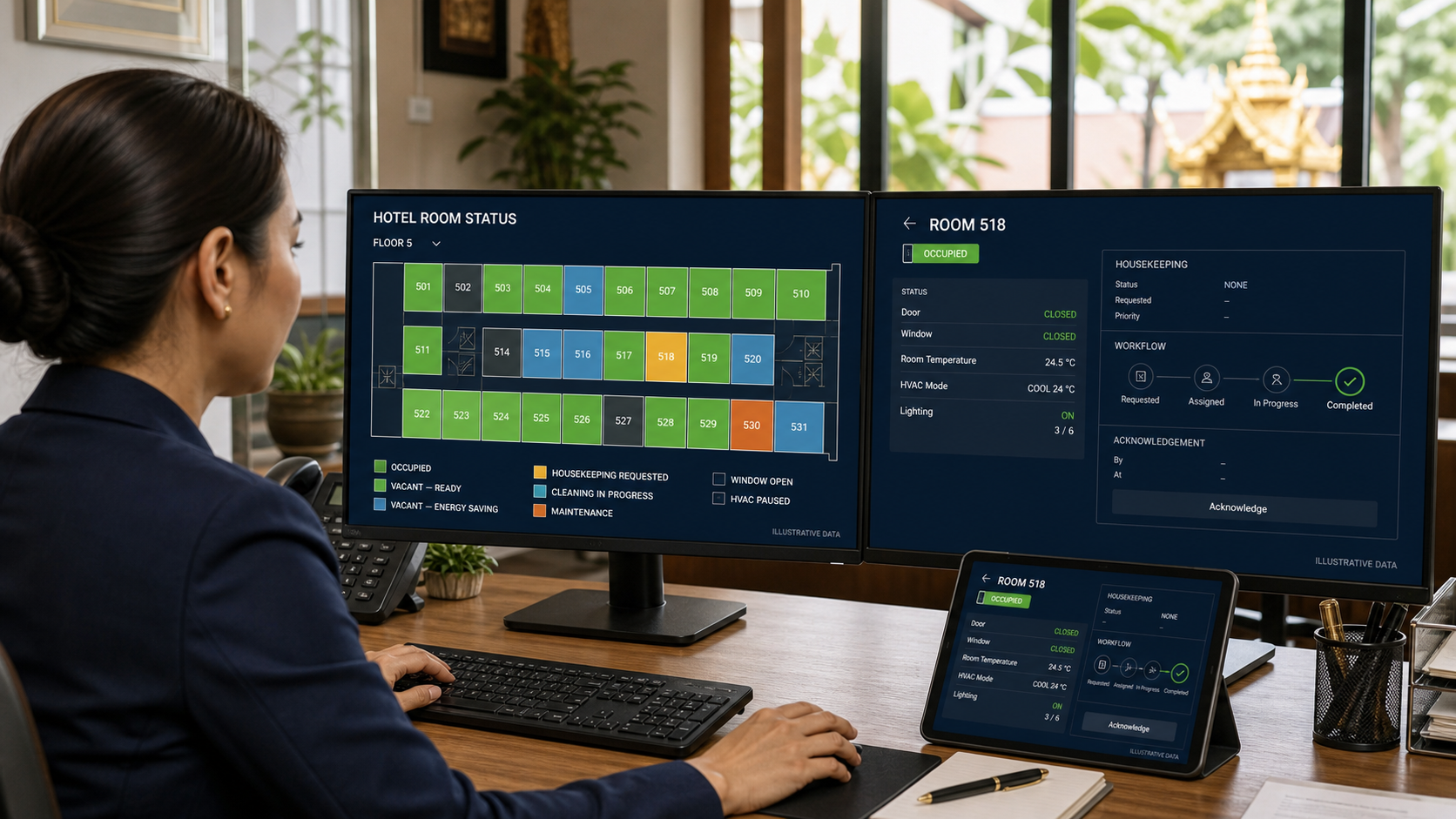
Guests experience the room—not its individual systems.
Lighting, temperature, shading, room scenes and service requests should feel intuitive to the guest. Behind that experience, clear operating modes and relevant room information can help hotel teams coordinate comfort, energy use and operational response.
Guest controls should remain simple even when the engineering behind them is sophisticated.
Six control functions to consider.
Guest-room scenes
Coordinate lighting, climate, shading and selected room functions for arrival, relaxation, sleep and departure.
Intuitive guest control
Provide clear and consistent controls that guests can understand without technical knowledge.
Room operating modes
Apply defined occupied, vacant, standby and service modes according to the approved hotel strategy.
Occupancy-aware operation
Use appropriate room-status information to coordinate comfort and reduce unnecessary operation.
Service-status information
Exchange relevant room requests and status information with authorised hotel operations where supported.
Operational visibility
Give authorised hotel teams useful information about room conditions and relevant system status.
Room behaviour can respond to each stage of the guest journey.
- 01
Prepare
Set the room to an appropriate condition before the guest arrives where the operational strategy supports it.
- 02
Welcome
Provide an intuitive arrival scene and clear access to essential room controls.
- 03
Stay
Support comfort, personal adjustment, service requests and predictable room behaviour.
- 04
Vacant
Return suitable functions to defined standby or economy modes after the room becomes vacant.
Room preparation follows the approved operational strategy. It does not imply access to booking or check-in data unless an approved integration is in place.
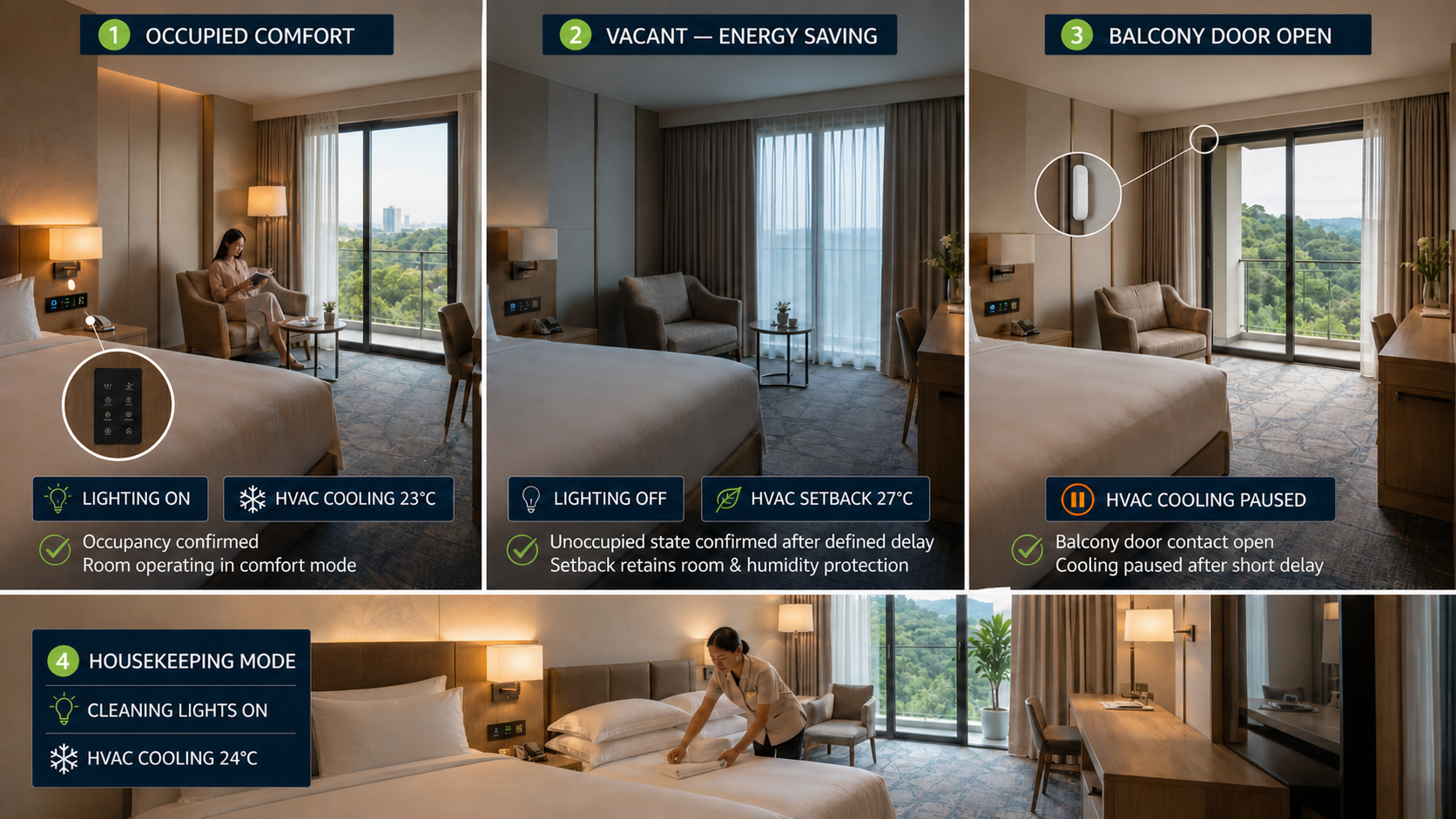
The right room conditions help staff work efficiently and maintain consistent room quality.
When authorised housekeeping or service staff enter the room, a defined service mode can automatically activate the designated cleaning lights and other required room functions. Clear, consistent illumination helps staff clean, inspect and prepare the room efficiently before it is returned to guest operation.
Defined cleaning scene
Activate the lighting required for cleaning and room inspection rather than relying on individual manual switching.
Efficient staff workflow
Reduce repetitive room-control actions so staff can focus on cleaning, inspection and preparation.
Consistent room inspection
Provide suitable illumination to help staff identify cleaning or maintenance items requiring attention.
Controlled return to guest mode
After service is complete, return the room to the approved vacant, standby or prepared condition.
- Only hotel-defined lighting and room functions are activated.
- Service modes do not override electrical protection or equipment safety functions.
- Activation follows an authorised staff action or an approved operational workflow.
- No identity tracking, staff monitoring or surveillance is intended or implied.
A defined service mode supports efficient work and consistent inspection conditions. It does not guarantee cleaning quality, which remains the responsibility of hotel procedures and staff.
Guest comfort and energy efficiency should be considered together.
Guest rooms may remain vacant for significant periods while lighting and cooling continue to consume energy. A coordinated room strategy can apply suitable comfort, standby and economy modes according to occupancy status and hotel requirements—without making the guest experience unpredictable.
Results depend on building design, equipment, occupancy patterns and hotel operation. No specific level of energy saving is guaranteed.
Use only the room information required for the intended function.
Many room-control functions require only defined states such as occupied, vacant, do-not-disturb or service requested. The project should define what information is necessary, who may access it and how operational privacy responsibilities are maintained.
Room-control functions use defined operational states. They are not intended for identity tracking, personal profiling or surveillance of guests or staff.
Integration should exchange defined information—not blur system responsibilities.
Where compatible and approved interfaces are available, relevant room status, service requests and operating-mode information may be exchanged with hotel operational platforms. Each system should retain responsibility for its dedicated functions, data and authorised actions.
Interface capability depends on the systems selected for the project and must be confirmed during design. No compatibility with any particular hotel platform is claimed.
The guest room becomes more coherent when its functions share relevant information.
Lighting, climate control, occupancy information, energy management and building monitoring can support a coordinated hospitality-control strategy while retaining appropriate system boundaries.
Hospitality control extends beyond the guest room.
Guest rooms
Comfort, lighting, shading, room scenes, status and intuitive guest control.
Suites and serviced residences
Coordinated functions for larger living, sleeping and service areas.
Public and circulation areas
Scheduled and occupancy-responsive operation for lobbies, corridors and shared spaces.
Back-office control
Practical monitoring and authorised control for staff, service and operational areas.
Hospitality control begins with the guest experience and operational workflow.
- Guest journey, room types and intended experience
- Room functions, scenes and user controls
- Occupancy states, delays and operating modes
- Hotel workflows and authorised information exchange
- Privacy, access and data responsibilities
- Fallback operation and manual control
- Mock-up room, testing and operational approval
The strategy should be coordinated with the hotel owner, operator, interior designer, electrical and mechanical designers, controls engineer and system integrator.
Planning a coordinated hospitality-control strategy?
Share the hotel concept, room types, guest-experience priorities and operational requirements with GreenControls.